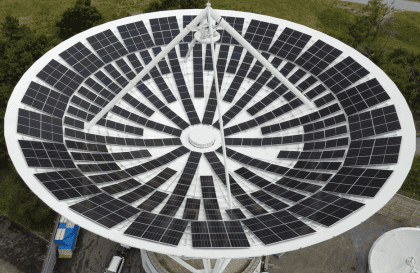
The project, developed in collaboration with global smart energy technology company, SolarEdge, exemplifies a bold approach to renewable energy by highlighting the potential of re-using existing infrastructure for solar.
Located in the town of Leuk, Switzerland, Leuk TDC initiated the idea of utilising old satellite dishes on their premises, originally constructed in 1972, as the foundation for a new solar plant designed to offset the energy requirements of its power-hungry data centre.
Recently installed, the solar plant comprises two satellite dishes with 307 solar panels on each one, with each dish generating approximately 110,000 kWh of clean energy annually. The company has also installed a rooftop solar system on the main building of its computing and data centre, generating a further 555,000 kWh of solar power annually. In addition to solar, the data centre is powered with energy from hydroelectric power plants, meaning the data centre’s entire energy needs are covered with 100% renewable energy.
Given the complex orientation and inclination of the solar panels on the satellite dishes, shadows and varied inclinations threatened to reduce the efficiency of the solar system. With traditional string solar inverters, they reduce the overall performance of the solar array to match the weakest performing panel on the string, meaning one shaded panel could reduce energy yield considerably.
As a result, SolarEdge’s DC-optimised inverter solution was used with power optimisers attached to the underside of every pair of solar panels. This enables the solar system to mitigate the impact of module mismatch on the satellite dishes, maximising energy production for Leuk TDC and ensuring the project was financially viable.
Deputy Head of Solar Technology for Central Switzerland at CKW, Manuel Jossi, the installer of the solar plant, said: “Having design flexibility with a solar installation is a huge benefit for installers. In complex cases such as these with uneven surfaces, without the use of power optimizers we simply would not have been able to achieve anywhere close to the level of energy being produced today. I recommend that others planning similar solar installations allocate sufficient time for planning and collaborate with trusted personnel to overcome any technical challenges.”
With Leuk TDC’s data centre requiring more and more power year on year, the company plans to continue leveraging solar energy and hydropower to power 100% of its data centre’s energy needs moving forward.
The company hopes the success of the satellite dish project serves as an inspiring model for future infrastructure innovations in renewable energy.
CEO at Leuk TDC, John Harris, said: “The need for the satellite dishes were becoming obsolete, so we always knew we wanted to make use of them in some way or another. The design of the dishes, which allows them to be aligned both horizontally and vertically, proved ideal for a solar panel installation. By following the sun’s path throughout the day, these dishes optimise solar radiation absorption. Having installed them, we get considerably more hours of electricity than conventional string system, and power optimisers enhance electricity production further.”
Photo: Unused satellite dishes are used to power Leuk TDC’s data centre, combined with hydroelectricity and a rooftop solar system, enabling the data centre to be 100% powered with renewable energy.
