Mark Krull, Director at LCL Awards, explores how battery storage is set to become a vital part of the UK’s energy future and how electricians can position themselves to take full advantage of the shift.
Despite the increasing emphasis on renewable energy solutions, the adoption of battery storage remains surprisingly low. This presents a significant opportunity for electrical engineers to lead the charge in integrating these systems into both residential and commercial settings.
As the UK focuses on decarbonisation of our electricity supply, batteries have quietly slipped under the radar. Despite headline-making solar farms and offshore wind projects, the UK’s deployment of battery storage remains low. Meeting carbon reduction targets presents a real opportunity for electrical engineers, with batteries a key tool in creating a stable and cost-effective energy future.
The case for battery storage
Battery storage, or electrical energy storage systems (EESS), offer benefits that few other technologies can match, enabling homeowners and businesses to store surplus renewable electricity and/or charge up with cheaper, off-peak electricity to be used when prices spike – shielding end-users from price swings driven by volatile market rates or unexpected outages. Reducing reliance on the grid results in increased energy independence.
From a grid perspective, distributed battery storage helps level out peaks and troughs in electricity supply and demand. By discharging during periods of high usage, batteries reduce strain on the grid, minimising the need for costly infrastructure reinforcements, and serving to enhance grid stability by flattening load curves.
Combine and save
The ideal setup for a low carbon future is to combine battery storage with other complementary green technologies, such as solar PV and EV charging, ensuring cost savings for the end-user and a pipeline of stable work and career prospects for the electricians who choose to upskill.
Apart from the benefits of generating your own power through solar PV, further savings can be made through specialist EV charging tariffs, for example, which will give you 5-6 hours charging at roughly 1/3 the normal price, usually overnight. If you charge a battery when costs are low, it can shoulder the burden during peak times, reducing energy bills overall.
Empowering electricians
Increasingly, homeowners and businesses will be looking for ways to remove themselves from pricing instability and move closer to net zero, battery storage is a key part of this process and offers a bright future, not only for the buildings that can be decarbonised, but also for the installers trained to facilitate its deployment.
For electrical engineers, this opens up a new set of challenges – optimising system sizing, integrating energy management software and ensuring compliance with developing safety standards.
Upskilling into these technologies, and adopting a consultative approach, electrical engineers can position themselves as a trusted energy adviser – strategically more valuable than a one-off installer. The role of the electrician here is to frame storage as both a resilience measure. The work is there – from standalone to fully integrated smart home energy systems – and the increasing energy needs of the future must be met by skilled professionals.
Advancements in training
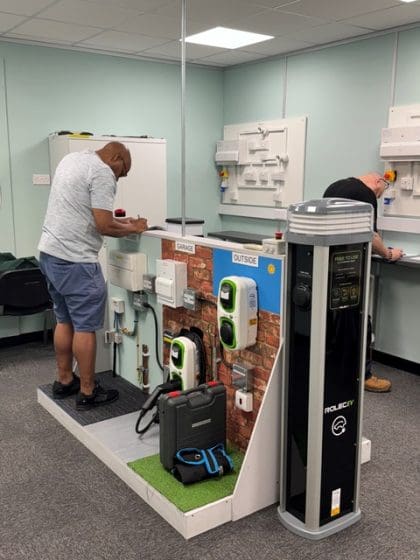
To capitalise on these opportunities, the industry must upskill. Many training providers have partnered with battery manufacturers to develop specialist courses covering what you need to know – electrical safety, IEC and EN standards, best practices commissioning protocols and software configuration. These modules blend educational theory with hands-on experience, equipping professionals with the skills necessary for proficient battery storage system installation and maintenance.
Future outlook
Battery storage is a key piece of the future energy jigsaw puzzle, and electrical engineers are in the perfect position to make the most of this growing market. Improvements in lithium-ion technology means batteries are getting lighter, and in time, costs should come down. Newer types of batteries – like solid-state, sodium ion and flow batteries – are also on the horizon, offering better performance and longer life. These improvements will make battery storage more accessible to many more people.
At the same time, smart energy management tools will be sophisticated enough to be able to calculate how much energy a home or building needs, how prices will change and how much solar power will be available. This will aid systems to run more efficiently without needing constant input from the user. Batteries are becoming easier to install, with simple, modular designs that reduce setup time and complexity.
Put together, these changes mean we’ll see a huge rise in battery storage across homes, businesses and the wider grid by 2030. Electrical engineers can help customers understand the benefits, design the right systems and stay up with the latest developments and safety compliance. It’s a bright future for battery storage and those acquire the understanding and skills to deliver them.
The LCL Awards Level 3 battery storage course is available from locations throughout the UK.
