The transition toward Net Zero is reshaping energy infrastructure across the UK and globally. As national policy accelerates decarbonisation, consumers and building operators & owners face increasing pressure from rising fuel prices, volatile energy markets, and the growing cost of goods and services. One of the most challenging sectors to decarbonise is the heating and hot water (H&HW) sector, which represents a significant proportion of national emissions.
Heating and hot water in buildings account for 37–38% of total UK carbon emissions, equivalent to roughly 32% of all greenhouse gas output. Direct emissions from residential and commercial heating alone contribute 17–23% of the national total. While legislation increasingly favours full electrification in new‑build properties, these developments represent only a small fraction of the UK’s building stock. The overwhelming majority consists of existing buildings, many of which are thermally inefficient, space‑constrained, or limited by electrical capacity.
Because of these constraints, a hybridised approach – integrating heat pumps with existing boiler systems – offers a technically robust and economically viable pathway for reducing emissions without imposing prohibitive operational costs.
Heat pumps as a decarbonisation technology
Heat pumps (air‑source, water‑source, and ground‑source) are widely promoted due to their ability to deliver more thermal energy than the electrical energy they consume. This performance advantage is quantified using the Coefficient of Performance (COP), defined as:

By contrast, boiler efficiency is expressed as a percentage:

Modern condensing boilers typically achieve efficiencies in the 88–94% range, where under optimal conditions, a boiler only achieves its highest efficiency when it is in condensing mode.
Cost‑efficiency misconceptions
A common misconception is that heat pumps are inherently more expensive to operate due to the higher unit cost of electricity relative to gas. However, when COP values exceed approximately 2.5. the price disparity between heat pumps and boilers is minimal, as seen by Figure 1.
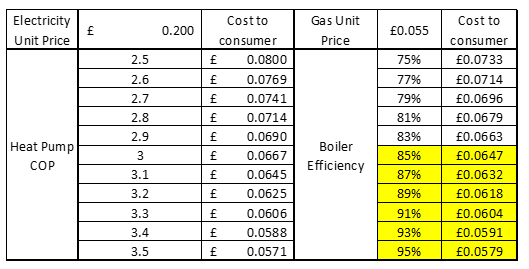
Figure 1: Cost of energy per kWh of heat delivered.
2. Temperature Sensitivity and System Efficiency
2.1 Heat Pump Performance Variables
Heat pump efficiency is highly sensitive to:
- Outdoor air temperature (for ASHPs)
- Required flow temperature to meet building heat demand
As outdoor air temperature decreases or the flow temperature increases, the compressor must work harder, in turn reducing the COP.
2.2 Boiler Efficiency Variables
Whilst the variables that affect the efficiency of boilers are:
- Higher return temperatures (>55–60°C) prevent condensing operation
- Lower system temperatures improve efficiency
In many existing buildings, legacy systems operate at 80°C flow / 60°C return, resulting in real‑world boiler efficiencies as low as 70% for older units and mid‑80% for modern condensing boilers.
Lowering system temperatures benefit both technologies, but heat pumps gain disproportionately, often surpassing boiler cost‑efficiency at moderate outdoor temperatures due to the big increase in COPs at lower temperatures for heat pumps.
3. The Case for Hybrid Heating Systems
A hybrid system can integrate heat pumps and boilers under a unified control strategy. This configuration leverages the strengths of each technology while mitigating their weaknesses.
3.1 Why Hybridisation Works
Hybrid systems:
- Reduce reliance on high‑carbon fuels without requiring full electrification
- Optimise operational cost by dynamically selecting the most efficient heat source
- Avoid expensive electrical upgrades
- Maintain resilience and redundancy
- Enable staged decarbonisation rather than disruptive system overhauls
This approach is particularly advantageous for buildings with:
- High peak heat loads
- Limited electrical capacity
- Poor insulation
- Space constraints
- Continuous heating requirements (e.g., care homes)
4. Technical Control Strategy for Hybrid Systems
The core of a hybrid system is the control logic that determines when the heat pump, boiler, or both should operate. We can use predetermined outdoor air temperatures to bring on the boilers to work with the heat pumps or just the boilers by themselves.
A calculation can be carried out using the end user’s unit rate to determine the economic balance point— determining the outdoor air temperature at which heat pump operation becomes more expensive per kWh of heat than boiler operation.
Above this temperature:
- Heat pump operates as primary heat source
- Boiler remains off or provides peak‑load support
Below this temperature:
- The Heat Pump and Boiler can operate together or
- Boiler takes over as primary heat source
- Heat pump may shut down or provide limited pre‑heat
This ensures the system always operates at minimum cost per delivered kWh.
5. Example: 100 kW Care Home Application
A care home with a continuous heating requirement provides a representative case study.
5.1 Operational Characteristics
- High annual heat demand
- Long heating season
- Need for reliability and redundancy
- Often limited electrical capacity
- 5.2 Hybrid System Benefits
- Heat pumps handle most of the heating during mild and moderate weatherBoilers provide peak‑load support during cold spells
- System temperatures can be reduced to improve overall efficiency
- Operators gain predictable running costs and reduced carbon intensity
6. Strategic Advantages of Hybrid Controls
- Dynamic control ensures the lowest‑cost heat source is always prioritised using predetermined set points.
- Heat pumps operate during periods of high COP and lower grid carbon intensity.
- Hybrid systems reduce peak electrical demand, supporting national decarbonisation goals.
- As insulation improves or tariffs shift, control parameters can be updated without replacing equipment.
It can allow end users to gradually switch to a point of use carbon free system.
Conclusion
Hybrid heating systems provide a technically sophisticated, economically rational pathway for decarbonising the UK’s existing building stock. By integrating heat pumps with boilers under intelligent control logic, operators can achieve:
- Lower operational costs
- Reduced carbon emissions
- Improved system resilience
- A scalable route toward full electrification
This approach acknowledges the practical constraints of existing buildings while enabling meaningful progress toward Net Zero
www.rinnai-uk.co.uk
